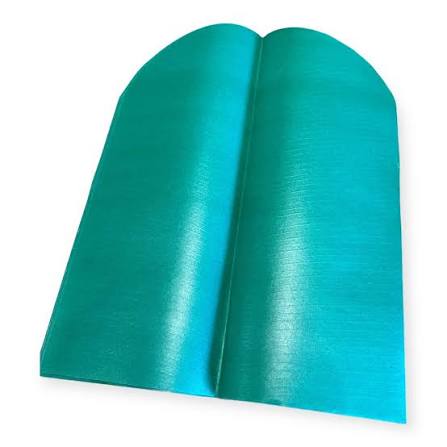
If you are hosting an Onam Sadhya in the United States, the leaf is the first problem you have to solve, usually before the menu. There are two realistic answers: track down fresh vazhayila, or use a paper banana leaf. Both work. They are good at different things.
The short answer
Use a paper banana leaf when you are serving a Sadhya to a group, need to plan ahead, or do not have a reliable source of fresh leaves nearby. Use a fresh leaf when the leaf itself is part of the cooking, when the occasion is formal enough that the real thing matters, or when you happen to live near a store that stocks them well.
Side by side
| Paper banana leaf | Fresh banana leaf | |
|---|---|---|
| Cost per leaf | $1.00, delivered | Roughly $1–$3 at an Indian grocery, higher in Onam week |
| Availability | Ordered online, shipped anywhere in the US | Depends entirely on a local Indian or Asian grocery |
| Buy in advance? | Yes — weeks or months ahead | No — a day or two at most |
| Shelf life | Indefinite, stored flat and dry | 1–2 days before wilting and browning |
| Preparation | Wipe with a barely damp cloth | Wash, trim the rib, sometimes pass over a flame to soften |
| Appearance | Convincing at table distance | The real thing — depth, sheen, scent |
| Aroma | None | Faint fresh-leaf scent, more so when warmed |
| Can you cook on it? | No — serving only | Yes — steaming, wrapping, grilling |
| Size consistency | Every leaf identical | Varies; large ones may need trimming |
| Cleanup | Fold and bin | Fold and bin or compost |
| Disposal | Paper; breaks down far faster than plastic | Fully compostable |
Where fresh leaves genuinely win
Two things a paper leaf cannot do.
Cooking. Anything where the leaf goes near heat needs a real one. Meen pollichathu, ada, elayappam, karimeen wrapped and grilled — the leaf is an ingredient there, contributing scent and moisture. A paper leaf near heat is a fire risk and nothing else.
The occasion itself. For a wedding Sadhya, a temple event or the first-rice ceremony, many families want the real leaf and are willing to do the work to get it. That is a reasonable preference and not one worth arguing with.
Where paper leaves win
Planning. This is the big one. Onam week is when fresh leaves are scarcest and most expensive, and it is exactly when you need them. Paper leaves let you buy in July for a September Sadhya and stop thinking about it.
Scale. Serving forty or a hundred people amplifies every problem with fresh leaves — sourcing that many at once, storing them, washing and trimming them the morning of, and dealing with the ones that arrived torn. A hundred paper leaves come in a box, identical, ready.
Distance from a source. If the nearest store that carries vazhayila is an hour's drive and may or may not have it, the comparison stops being about the leaf.
What about plastic or foam plates?
They work, obviously, and nobody will go hungry. But the point of a Sadhya is a row of green leaves with rice in the middle, and a paper leaf preserves that for about the same money and the same effort as a disposable plate. It is the only substitute that keeps the picture intact.
Cost, worked through
For a 20-person Sadhya: 20 Paper Vazha Ela is $20 plus $5 flat shipping, so $25 delivered, ordered whenever suits you. Twenty fresh leaves at Onam-week prices is likely $30–$50 plus the drive, plus the morning spent washing and trimming, plus the possibility that the store sold out on Tuesday.
At 100 people the gap widens considerably. See how many leaves you need for the counts.
Frequently asked questions
Is a paper banana leaf a good substitute for a real banana leaf?
For serving, yes. A paper banana leaf holds rice, sambar and curries the same way a fresh leaf does and is laid out identically. It cannot be used for cooking, steaming or wrapping food over heat, which is where a fresh leaf is genuinely irreplaceable.
Which is cheaper, paper banana leaf or fresh banana leaf?
Paper is usually cheaper once you count the trip. Paper Vazha Ela is $1.00 a leaf delivered. Fresh leaves run roughly $1 to $3 each at an Indian grocery in the US, rise sharply in Onam week, and carry the cost of getting there and the risk of the store being sold out.
How long do paper banana leaves last?
Indefinitely, as long as they are stored flat, dry and out of direct sunlight. That is the main practical advantage over fresh leaves, which wilt and brown within a day or two of arriving and cannot be bought far in advance.
Can you cook or microwave on a paper banana leaf?
No. Paper Vazha Ela is for serving only. Keep it away from open flame, ovens, microwaves and steamers. Use fresh leaves for anything cooked in or on the leaf, such as meen pollichathu or ada.
Do paper banana leaves look like real ones on the table?
At a set table, close. They are cut to a banana-leaf outline and coloured the familiar green, so a laid row reads as a Sadhya row. Up close a fresh leaf still has depth and a natural sheen that printed paper does not reproduce.
Are paper banana leaves biodegradable?
They are paper, so they break down far faster than plastic or foam disposables, but a fresh leaf is fully compostable and a paper leaf with food residue generally is not accepted by municipal composting. Check your local rules; most households put used paper leaves in general waste.
Order Paper Vazha Ela
Packs of 10, 20, 30, 40, 50 and 100 — $1.00 a leaf, flat $5 shipping, United States only.